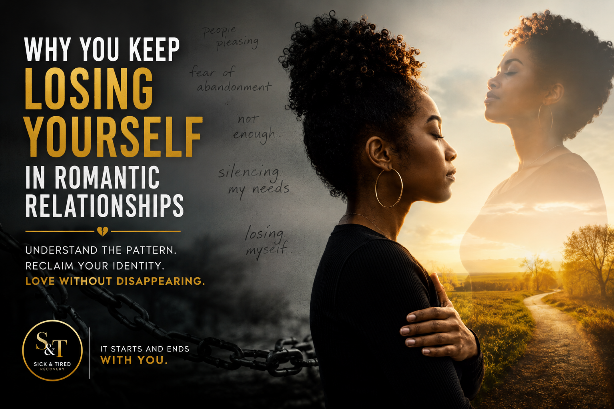
Why You Keep Losing Yourself in Romantic Relationships (And How to Stop)
At some point, many people look back on a relationship and ask the same question: How did I become someone I don’t recognize?
Not suddenly. Not dramatically. But slowly… almost invisibly.
You didn’t wake up one day and lose yourself. You adjusted. You softened edges. You stayed quiet when something bothered you. You said yes when you meant no. You told yourself it was love, compromise, maturity.
But underneath it all, something else was happening.
You were slowly abandoning yourself to keep the connection alive.
It Doesn’t Start as Losing Yourself
Most people assume they lose themselves because they love too deeply. That’s only partly true.
What actually drives this pattern is usually something older:
A fear of being left
A need to be chosen
A belief that love has to be earned
A discomfort with conflict or rejection
These patterns often form long before the relationship begins. Through the lens of Attachment Theory, people develop emotional strategies early in life that shape how they connect later. Some learn to pursue closeness by becoming overly accommodating. Others learn to suppress their needs to avoid losing connection.
So when romance enters the picture, it doesn’t create the problem—it activates it.
The Slow Drift Away From Yourself
Losing yourself in a relationship rarely looks like a single decision. It looks like a thousand small ones.
You start adapting your opinions so there’s less tension.
You stop bringing up things that “aren’t worth the argument.”
You begin to monitor your tone, your timing, your emotions.
You become more focused on how they feel than how you feel.
At first, it feels like love. It feels like being understanding. It feels like growth.
But over time, something shifts.
You’re no longer asking, Do I like this?
You’re asking, Will this keep them close?
That’s the turning point.
When Love Becomes Emotional Survival
A healthy relationship expands your sense of self. But when fear is driving the connection, love starts to feel like something you have to maintain rather than experience.
You begin to manage the relationship instead of participate in it.
This is where emotional fusion shows up—you start to blur the line between your feelings and theirs. Their mood becomes your responsibility. Their distance becomes your anxiety. Their approval becomes your stability.
You stop living inside your own inner world and start living inside the relationship dynamic.
And without noticing it, your identity starts to shrink.
The Role of Self-Abandonment
Here’s the uncomfortable truth: most people don’t get “lost” in relationships. They self-abandon in order to stay in them.
Self-abandonment looks like:
Ignoring your intuition because you don’t want to “overreact”
Staying quiet to avoid being “too much”
Over-explaining your needs so they don’t feel like demands
Tolerating behavior that doesn’t align with your values
None of this feels extreme in the moment. That’s what makes it dangerous. It feels reasonable. It feels loving. It feels like being the “bigger person.”
But over time, you start losing access to your own voice.
Why It’s So Hard to Stop
If this pattern is so painful, why does it repeat?
Because it often feels safer than honesty.
Honesty risks conflict. It risks rejection. It risks losing connection.
And for someone with abandonment sensitivity, that risk can feel unbearable.
So the nervous system chooses the familiar pattern:
stay connected, even if it costs you yourself.
This is why awareness alone isn’t enough. You don’t just “realize” the pattern—you have to learn to tolerate the discomfort of staying rooted in yourself while still staying connected to someone else.
That’s a skill. Not a realization.
Rebuilding Your Sense of Self
The way out isn’t becoming detached or indifferent. It’s rebuilding internal clarity.
Start here:
Notice when you’re editing yourself in real time
Ask, What do I actually feel before I react?
Separate love from fear of loss
Practice saying small truths before big ones
The goal isn’t to become rigid. It’s to become present to yourself again.
Healthy love doesn’t require you to disappear. It requires you to remain.
Final Thought
If you’ve lost yourself in relationships before, it doesn’t mean you’re weak or broken. It means you learned to prioritize connection over self-trust.
But that pattern isn’t your identity—it’s a strategy.
And strategies can change.
Real love doesn’t ask you to abandon yourself to keep it. It invites you to show up fully, even when it’s uncomfortable, even when it risks disagreement, even when it means being seen clearly.
Because the version of you worth loving… is the one who stays with himself while loving someone else.

You Can’t Choose Recovery for Someone Else