Somewhere Along the Way, I Stopped Being Me
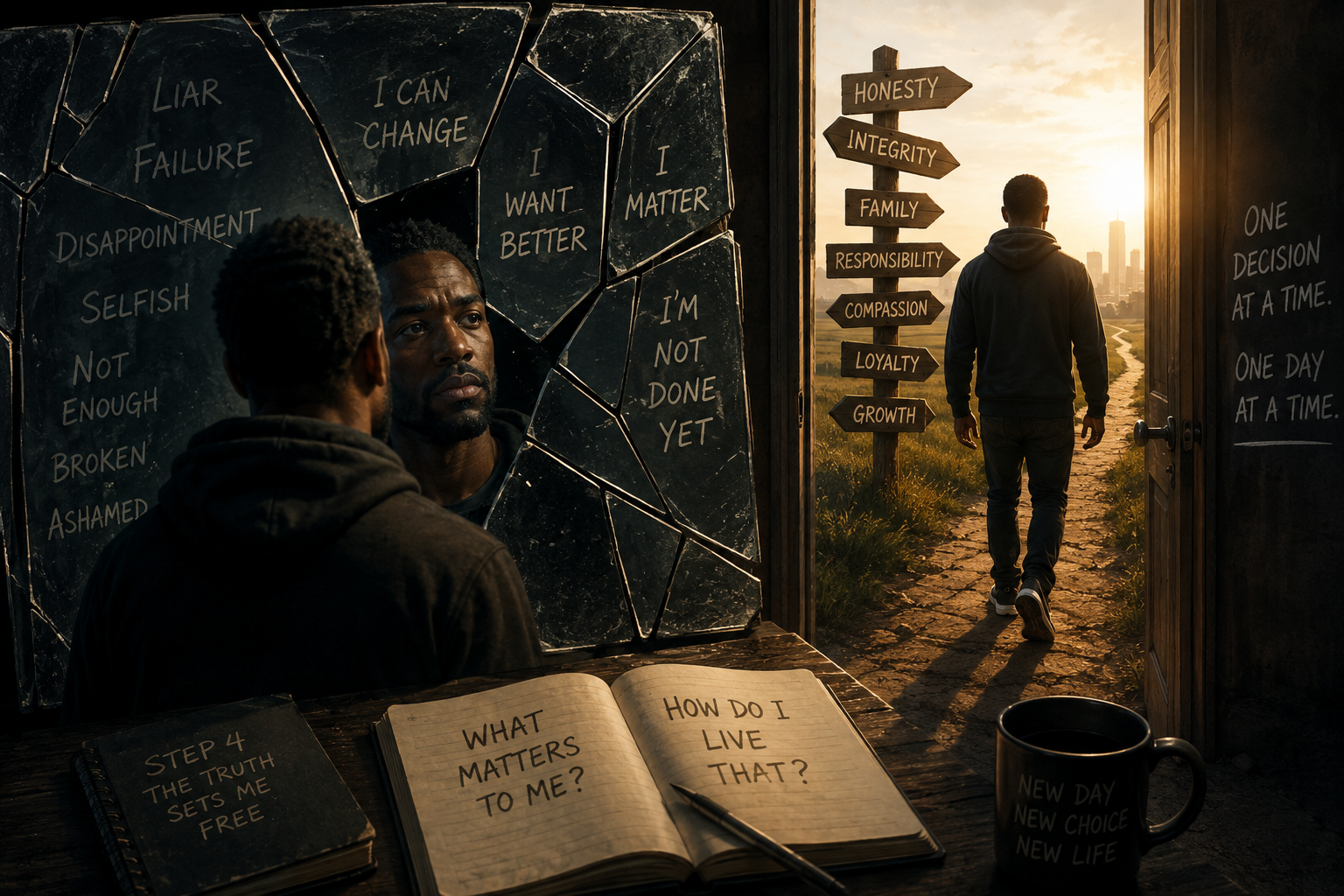
Have you ever looked at your life and thought, “How did I become this person?”
You lie about things you don't even need to lie about.
You avoid people because you don't want them asking questions.
You make promises and already know there's a good chance you won't keep them.
You tell yourself you're going to do better tomorrow, but tomorrow comes and nothing changes.
You hurt people you love.
You stop answering the phone.
You look in the mirror and don't really like the person looking back at you.
And somewhere along the way, you start believing:
Maybe this is just who I am.
I want to challenge that.
One of the things our book talks about in Step 4 is digging deep to see how we lived in conflict with our own morals and values. It talks about exploring how we felt when we ignored our deepest beliefs and discovering our lost values so we can begin rebuilding them.
That word lost matters.
Because you can't lose something you never had.
Think about the things you feel guilty about.
Why do they bother you?
If honesty didn't matter to you, lying wouldn't create an internal conflict.
If being there for your family didn't matter, letting them down wouldn't hurt.
If being trustworthy didn't matter, losing someone's trust wouldn't bother you.
Sometimes the pain isn't proof that you're a terrible person.
Sometimes the pain is telling you:
“This isn't how I want to live.”
That's important, because when we've lived against our values long enough, we can start confusing our behavior with our identity.
We stop saying, “I've been dishonest,” and start saying, “I'm a liar.”
We stop saying, “I've made some terrible choices,” and start saying, “I'm a terrible person.”
We stop saying, “I've failed,” and start saying, “I'm a failure.”
There's a big difference.
Now, don't use this as an excuse.
You still have to own what you did.
If you hurt somebody, you hurt them. If you broke trust, you broke trust. Recovery doesn't give us permission to hide behind “That's not who I really am.”
But accountability isn't the same thing as condemnation.
You can take responsibility for who you've been and still decide who you're going to become.
So here's something I want you to try.
Instead of only asking yourself, “What's wrong with me?”
Ask:
“What does my guilt tell me matters to me?”
Maybe you're ashamed of lying because honesty matters.
Maybe you regret not being there for your children because being a present parent matters.
Maybe you're tired of taking from people because you actually want to be someone who gives.
Maybe you're exhausted from pretending because deep down you value being real.
Those are clues.
Don't just stare at what you did wrong.
Look underneath it for the value you stopped living.
Then pick one.
Don't try to rebuild your entire life today.
Pick one value and ask yourself:
“What would it look like to live this value today?”
If it's honesty, tell one truth you've been avoiding.
If it's responsibility, handle one thing you've been putting off.
If it's family, make the call.
If it's integrity, do the right thing even if nobody will know.
That's how we start rebuilding ourselves.
Not by announcing that we've changed.
Not by beating ourselves up over who we've been.
But by making small decisions that agree with the person we want to become.
Maybe the reason you don't recognize yourself anymore isn't because the person you used to be is gone.
Maybe you've just been living too far away from what matters to you.
And recovery gives us a way back.
Find the value.
Live the value.
Then do it again tomorrow.
That's how we start finding ourselves again.

You Can’t Choose Recovery for Someone Else
